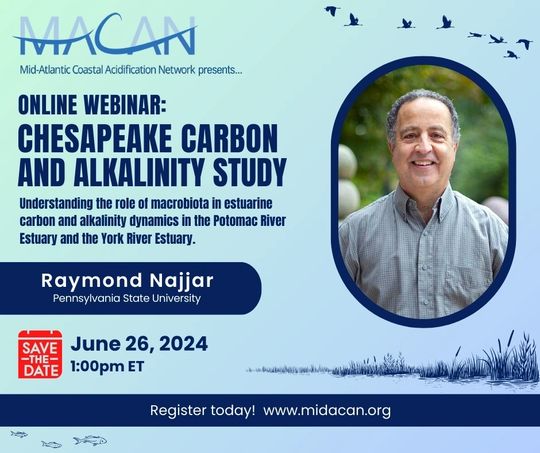
Pennsylvania State University) discussed the
Chesapeake Carbon and Alkalinity Study (CHALK), a new three-year interdisciplinary project funded by the
National Science Foundation, focused on improving understanding of the role that macrobiota play in estuarine carbon alkalinity dynamics.
The Chesapeake Carbon and Alkalinity Study, CHALK, is a coordinated program of field measurements, laboratory experiments, historical data analysis, and numerical modeling. Research is focused on two contrasting tidal tributaries of the Chesapeake Bay, the Potomac River Estuary and the York River Estuary. Our interdisciplinary research team is evaluating hypotheses about the role of tidal wetlands, benthic fauna, and submerged vegetation in estuarine carbon and alkalinity dynamics. The research plan includes seven main elements: (1) carbonate system measurements, (2) benthic fauna distribution measurements, (3) measurements of macrobiota carbon and alkalinity fluxes, (4) extrapolation of those fluxes across space and time, (5) historical analysis of carbonate system measurements, (6) 3-D numerical modeling, and (7) a meta-analysis that extends findings to other systems. Mentoring and inclusion occur through the development of a research affinity group connecting existing regional undergraduate research programs. This research will advance the understanding of how macrobiota influence estuarine carbon and alkalinity dynamics and, ultimately, the large-scale marine cycles of carbon and alkalinity.