Ocean Acidification (OA) is a pressing environmental concern that affects the health of our oceans and the people who use them.
Overview
Why It Matters
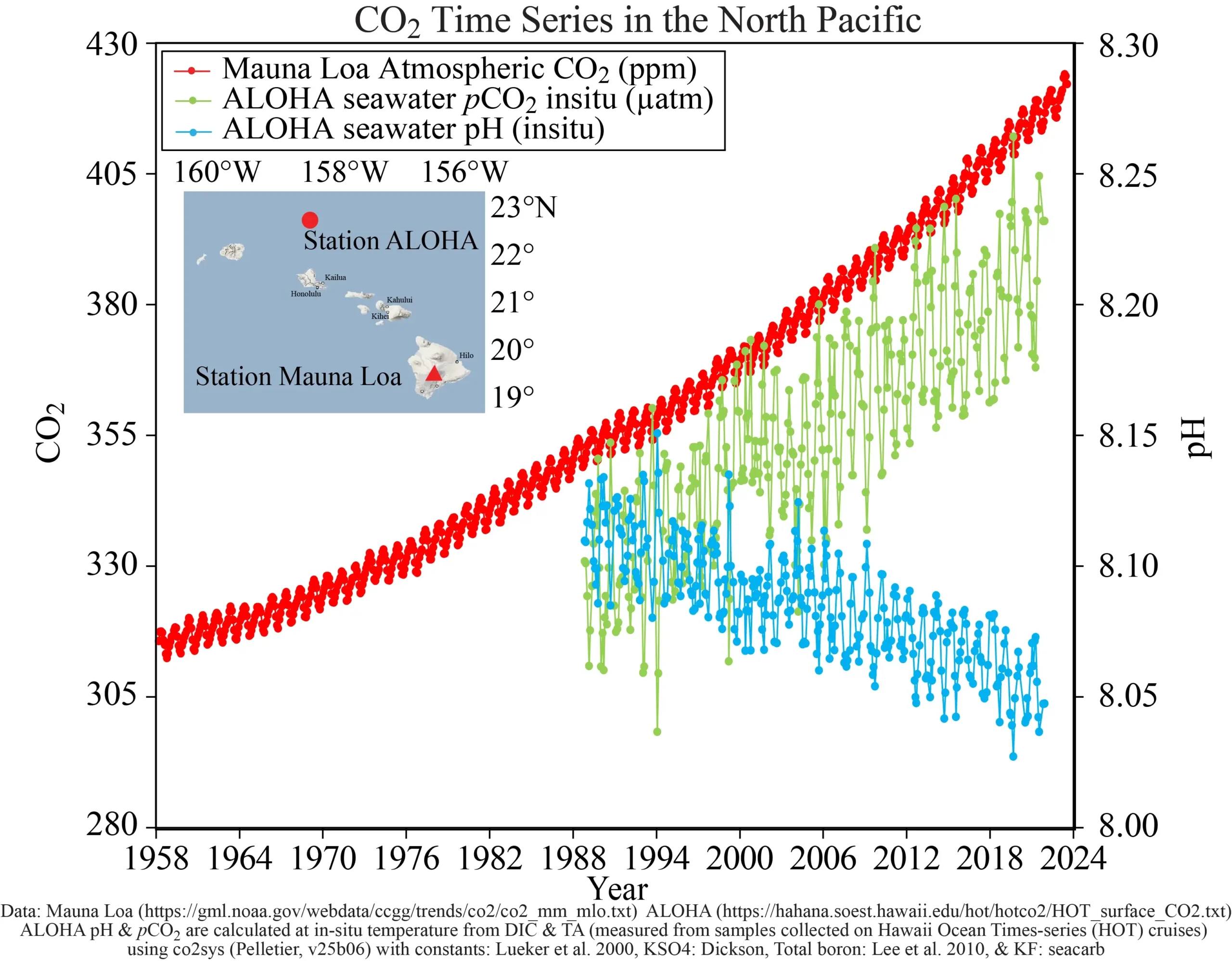
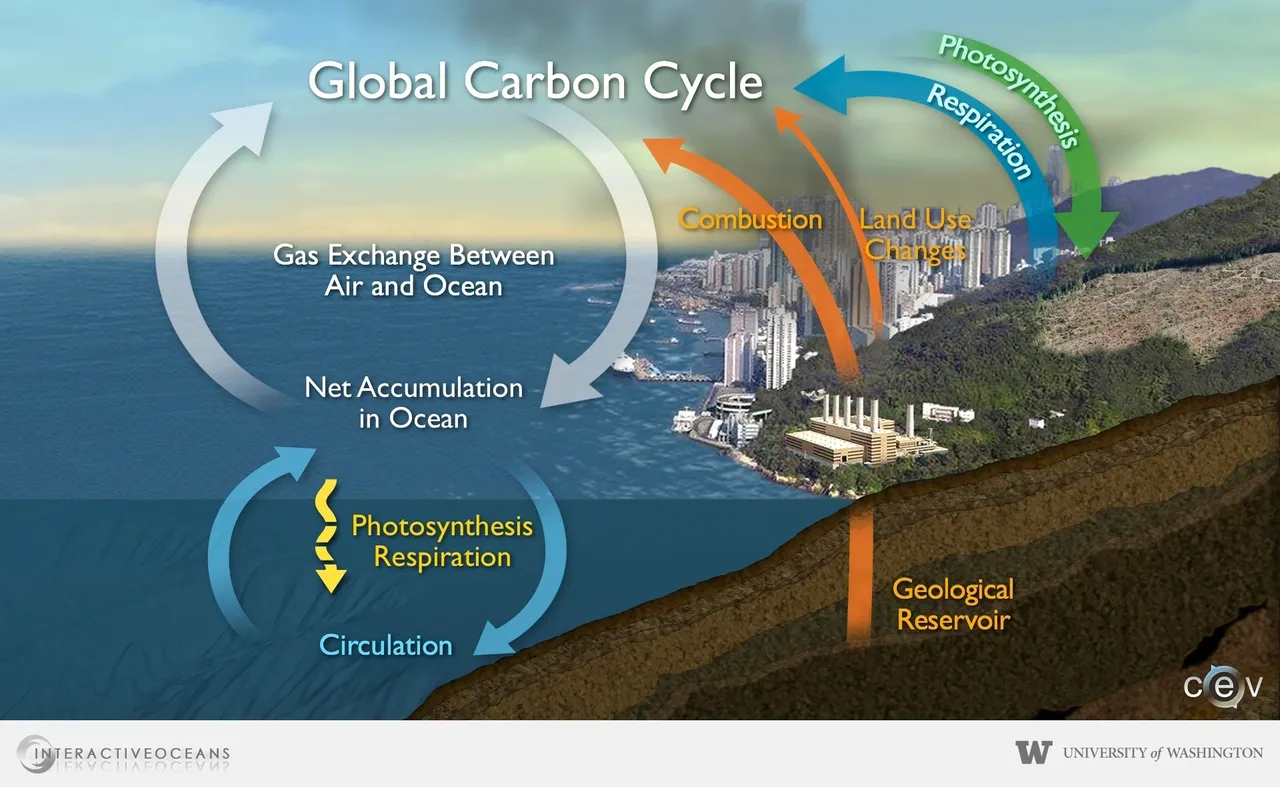
Carbon dioxide gas dissolves so readily in seawater that approximately one quarter of human caused CO₂ emissions become sequestered in the ocean. Once in the ocean, CO₂ combines with water to form a weak acid, resulting in a change in the chemistry of the sea. As the CO₂ increases, the pH decreases; indicating increasing acidificication.
Changes in Chemistry Impact Marine Plants and Animals
Ocean acidification also influences CO₂-driven changes in the solubility of calcium carbonate minerals (CaCO₃) used by many marine plants and animals to build their shells and skeletons.
The solubility of CaCO₃ minerals depend on the amount of dissolved carbonate ions in seawater.
More CO₂ and lower pH reduces the concentration of carbonate ions, making it more difficult for many organisms to make shell material.
Ocean CO₂ and pH from NOAA: Correlation between rising levels of CO₂ in the atmosphere at Mauna Loa with rising CO₂ levels in ocean at Station Aloha. As the CO₂ increases, the pH decreases; indicating increasing acidificication.
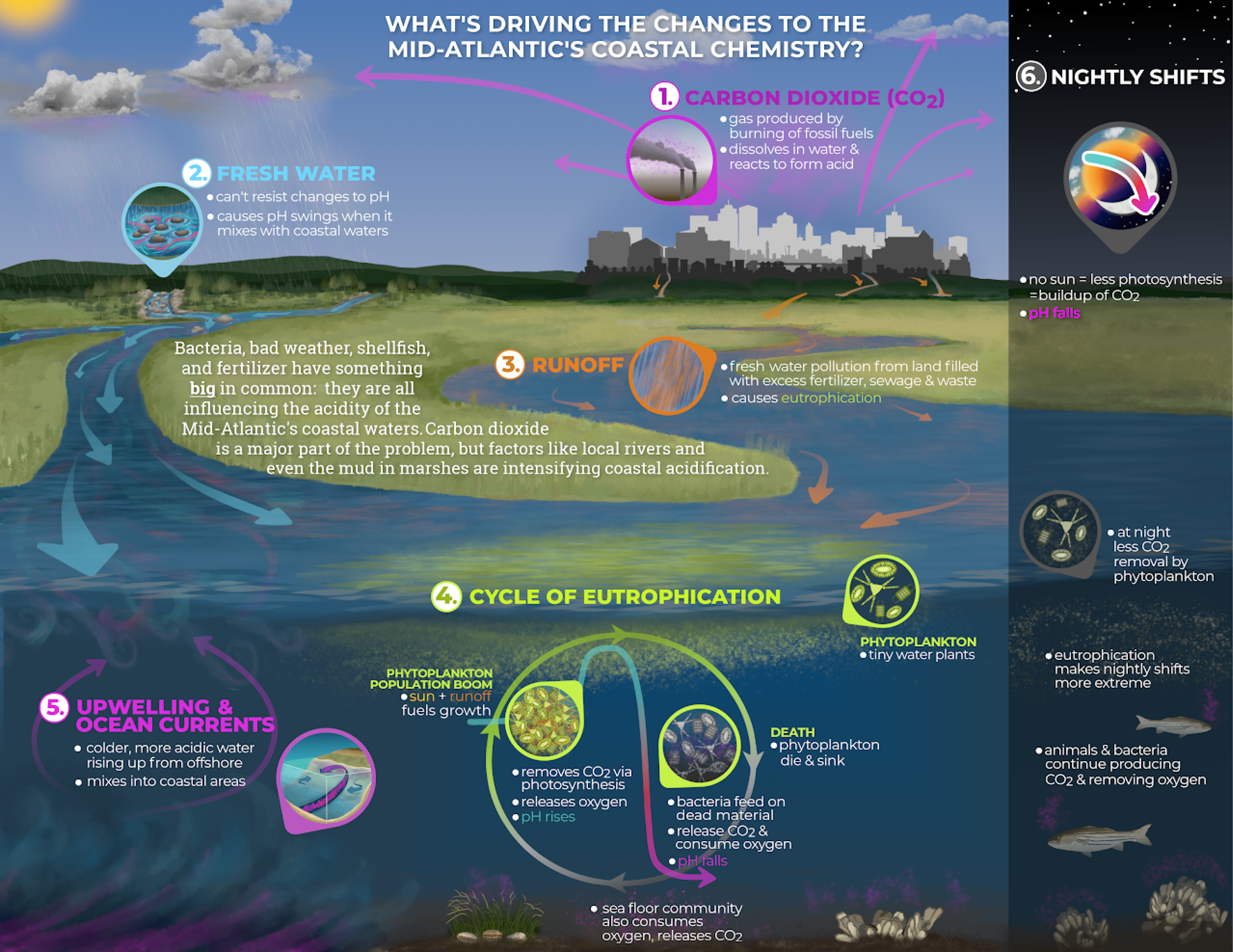
If larger animals like fish and shellfish do not consume the algae blooms, the organic material will be broken down by bacteria leading to conditions of low oxygen called hypoxia.
Bacterial respiration not only consumes oxygen, but also produces CO₂, which results in seasonal decreases in pH in excess of the acidification driven by the atmospheric CO₂. This is a particularly serious issue compounding acidification in the Mid-Atlantic estuaries.
References
EK Towle, AC Baker, C Langdon. 2016. Preconditioning to high CO2 exacerbates the response of the Caribbean branching coral Poritesporites to high temperature stress. Marine Ecology Progress Series; 546: 75-84. DOI: 10.3354/meps11655. https://doi.org/10.3354/meps11655
E Ramirez-Llodra, PA Tyler, MC Baker, OA Bergstad, MR Clark, E Escobar, LA Levin, L Menot, AA Rowden, CR Smith, CL Van Dover. 2011. Man and the last great wilderness: human impact on the deep sea. PLoS ONE 6(8): e22588. https://doi.org/10.1371/journal.pone.0022588
RC Chambers, AC Candelmo, EA Habeck, ME Poach, D Wieczorek, KR Cooper, CE Greenfield, and BA Phelan. 2014. Effects of elevated CO2 in the early life stages of summer flounder, Paralichthys dentatus, and potential consequences of ocean acidification. Biogeosciences 11.6: 1613-1626. https://doi.org/10.5194/bg-11-1613-2014
GG Waldbusser, EP Voigt, H Bergschneider, MA Green, RIE Newell. 2011. Biocalcification in the eastern oyster (Crassostrea virginica) in relation to long-term trends in Chesapeake Bay pH. Estuaries and Coasts 34.2: 221-231. https://doi.org/10.1007/s12237-010-9307-0
E Ramirez-Llodra, PA Tyler, MC Baker, OA Bergstad, MR Clark, E Escobar, LA Levin, L Menot, AA Rowden, CR Smith, CL Van Dover. 2011. Man and the last great wilderness: human impact on the deep sea. PLoS ONE 6(8): e22588.
Ekstrom, J. A., Suatoni, L., Cooley, S. R., Pendleton, L. H., Waldbusser, G. G., Cinner, J. E., Ritter, J., Langdon, C., Van Hooidonk, R., Gledhill, D., Wellman, K., Beck, M. W., Brander, L. M., Rittschof, D., Doherty, C., Edwards, P. E. T., & Portela, R. (2015). Vulnerability and adaptation of US shellfisheries to ocean acidification. Nature Climate Change, 5(3), 207–214. https://doi.org/10.1038/nclimate2508
Wang, Z. A., Wanninkhof, R., Cai, W.-J., Byrne, R. H., Hu, X., PenSabag, T.-H., & Huang, W.-J. (2013). The marine inorganic carbon system along the Gulf of Mexico and Atlantic coasts of the United States: Insights from a transregional coastal carbon study. Limnology and Oceanography, 58(1), 325–342. https://doi.org/10.4319/lo.2013.58.1.0325